Guide to Nuremberg Rally Grounds + Documentation Center

Travel With Kinsley contains affiliate links and is a member of the Amazon Services LLC Associates Program, which means I may receive a cute little commission if you purchase through my links, at no extra cost to you. Please read full disclosure for more information.
The Documentation Center Nazi Party Rally Grounds is a museum and educational center located in Nuremberg, Germany.
When Zack and I planned our trip to Germany, we wanted to add in some more historical activities to our to-do list. We added this as one of our top things to do in Nuremberg.
The Documentation Center Nazi Party Rally Grounds, or Dokumentationszentrum Reichsparteitagsgelände, is situated within the remaining structures of the Nazi Party Rally Grounds, where the National Socialist German Workers’ Party (NSDAP) held its mass rallies during the 1930s.
The site is historically significant because it was designed to showcase and reinforce the power of the Nazi regime through grandiose architecture and propaganda events.

Are the Nuremberg Rally Grounds worth visiting?
Yes, visiting the Nuremberg Rally Grounds can be a profoundly moving and educational experience, depending on your interests in history, particularly the history of the 20th century and World War II.
The Nuremberg Rally Grounds were the site of the massive Nazi Party rallies held annually from 1933 to 1938. These rallies were key events in Nazi propaganda, designed to showcase the power and unity of the Nazi regime.
The Documentation Center Nazi Party Rally Grounds, located in the unfinished Congress Hall, offers a comprehensive exhibition on the rise of the Nazi Party, the rallies, and the consequences of the regime’s policies, including World War II and the Holocaust.
The Nazi Party Rally Grounds were intended to be a monumental site for mass gatherings, covering an area of about 11 square kilometers.
These rallies were designed to showcase the might of the Nazi regime, with hundreds of thousands of participants and spectators. The area included several massive structures, such as the Zeppelin Field, the Congress Hall, and the Great Road, though many of these buildings were never fully completed.

Getting to the Nuremberg Rally Grounds
U-Bahn (Subway)
- Line U1: Take the U1 subway line from Nuremberg Hauptbahnhof (main train station) or any other central station and get off at “Lorenzkirche” or “Hauptbahnhof.” From there, transfer to Line U2 heading towards “Langwasser Süd.”
- Stop: Get off at “Doku-Zentrum” (Documentation Center) station, which is the closest stop to the Nuremberg Rally Grounds and the Documentation Center Nazi Party Rally Grounds. The station is about a 5-10 minute walk from the entrance to the Documentation Center and the main rally grounds.
Tram
- Line 9: Take tram line 9 and get off at the “Doku-Zentrum” stop, which is directly adjacent to the Documentation Center and the Rally Grounds.
Bus
- Bus Lines 36 and 55: These bus lines also stop near the Rally Grounds. Look for stops such as “Doku-Zentrum” or “Zeppelinfeld.”

What to see at the Nuremberg Rally Grounds
1. Documentation Center Nazi Party Rally Grounds
Exhibition “Fascination and Terror”: This is the main exhibition at the Documentation Center, located in the unfinished Congress Hall. It provides a comprehensive and sobering look at the rise of the Nazi Party, the role of the Nuremberg rallies in Nazi propaganda, and the devastating consequences of the regime’s policies, including World War II and the Holocaust. The exhibition includes photographs, documents, films, and interactive displays.
The Documentation Center is housed in what was intended to be the Nazi Congress Hall, a massive, unfinished structure inspired by the Colosseum in Rome. The building itself is a powerful symbol of the grandiosity and ultimate failure of the Nazi regime.


 |
 |

 |
 |

 |
 |

2. Zeppelin Field (Zeppelinfeld)
Main Tribune (Grandstand): The Zeppelin Field is where the most famous Nazi rallies were held. The grandstand, designed by Albert Speer, was the centerpiece of these events, where Adolf Hitler and other Nazi leaders addressed the masses. Although much of the structure has deteriorated, parts of the grandstand remain, offering a chilling glimpse into the scale and spectacle of the rallies.
This location is where some of the most iconic and infamous images of the Nazi rallies were captured. Standing on the grounds allows visitors to understand the sheer size and orchestrated power displays that were central to Nazi propaganda.
 |
 |
 |
 |
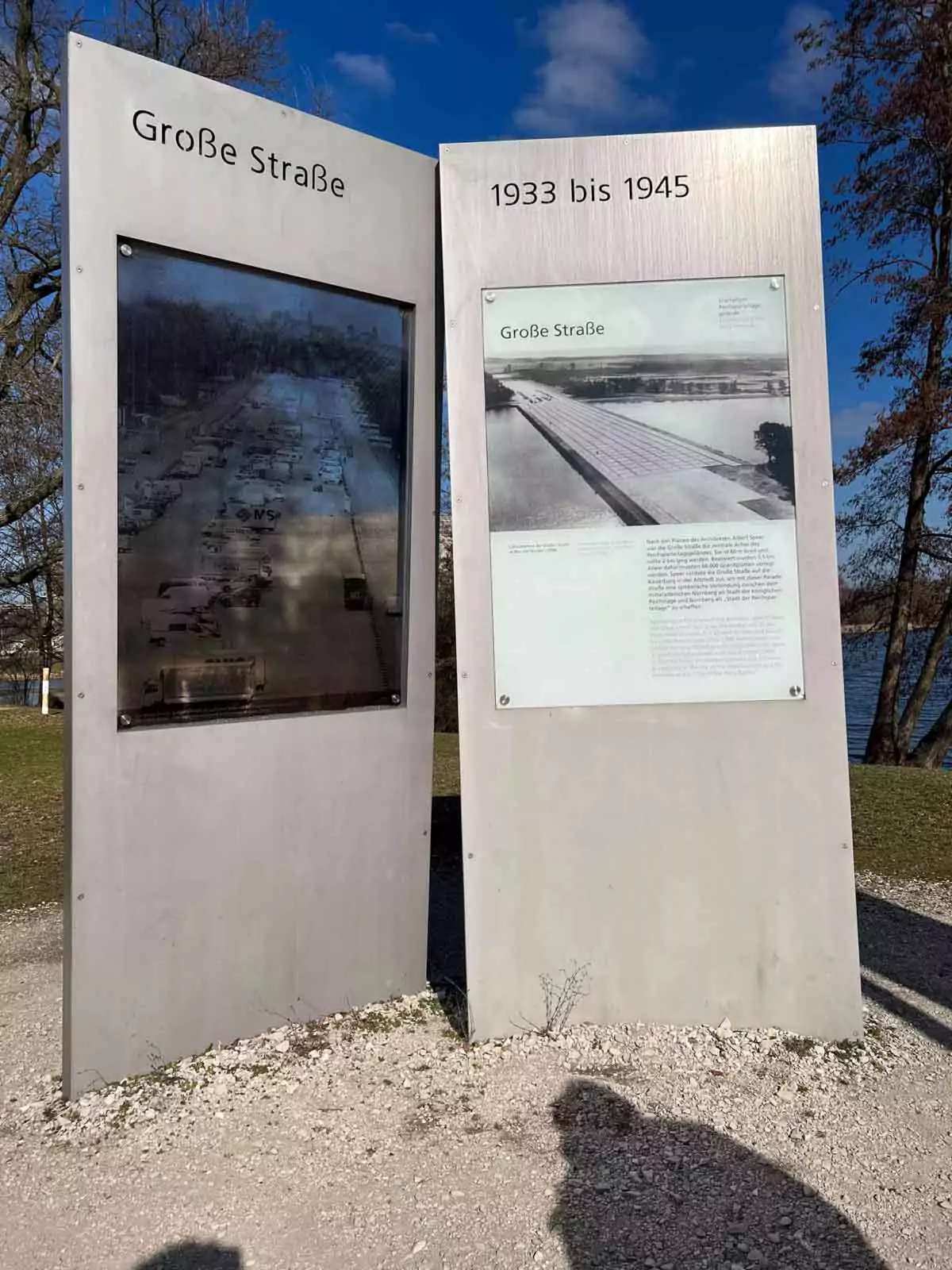
3. The Great Road (Große Straße)
The Great Road was designed as a massive parade route, intended for military demonstrations and marches during the rallies. The road stretches 2 kilometers (about 1.2 miles) and is flanked by grandiose architecture, symbolizing the Nazi regime’s might. Although the road is not fully utilized today, walking along it provides a sense of the scale of Nazi ambitions.
The road was never completed to its full intended use, and its emptiness today serves as a stark reminder of the regime’s ultimate collapse.

4. Congress Hall (Kongresshalle)
The Congress Hall was designed to be a massive assembly hall for the Nazi Party, with a capacity of 50,000 people. The building was never completed, but the exterior and parts of the interior are accessible. Its monumental scale and unfinished state symbolize the regime’s grandiose ambitions and eventual downfall.
5. Luitpold Arena and Luitpold Hall
The Luitpold Arena was another key rally location where massive military parades and formations were held. The Luitpold Hall, which was destroyed during World War II, was used for Nazi party meetings. Today, much of the site is a park, but remnants of the original structures can still be seen, including the Ehrenhalle (Hall of Honor), which was preserved as a memorial to German soldiers who died in World War I.
The area now includes memorials that reflect on the events that took place there and the impact of the Nazi regime.
6. The March Field (Märzfeld)
The March Field was intended to be a massive parade ground for displaying military strength. It was never fully completed, but parts of the grandstands and the foundation of the structures remain. The site provides insight into the extent of Nazi planning for propaganda and military displays.
Today, much of the area is overgrown, and the ruins serve as a stark contrast to the original plans, symbolizing the regime’s collapse.

7. Silbersee (Silver Lake)
Originally a quarry for the stones used in the construction of the Rally Grounds, the Silbersee (Silver Lake) was created after the quarry filled with water. It is now a peaceful area, contrasting with its dark history, and serves as a reminder of the exploitation of resources for the Nazi building projects.


Visiting the Nuremberg Rally Grounds
Address: Bayernstraße 110 90478 Nuremberg
You can walk around the Rally Grounds to see the remnants of the original structures and gain a sense of the scale and ambition of the Nazi plans.
The site is a powerful reminder of the dangers of propaganda and mass manipulation, as well as the importance of historical memory.
For the most up-to-date information on hours, especially during holidays or special events, it’s recommended to check the official website of the Documentation Center or contact them directly before your visit.
Hours
The hours for visiting the Nuremberg Rally Grounds vary depending on which part of the site you’re visiting, particularly the Documentation Center Nazi Party Rally Grounds.
Documentation Center Nazi Party Rally Grounds
- Regular Hours:
- Monday to Friday: 9:00 AM to 6:00 PM
- Saturday, Sunday, and Public Holidays: 10:00 AM to 6:00 PM
- Last Admission: Typically 45 minutes before closing time.
- Closed: The Documentation Center is usually closed on December 24th and 31st.
The Rally Grounds (Outdoor Areas)
- The outdoor areas of the Nuremberg Rally Grounds, including the Zeppelin Field, the Great Road, and other open spaces, are generally accessible to the public at all times.
- Note: While you can walk around these areas freely, the best time to visit is during daylight hours for safety and to get the most out of your experience.
Guided Tours and Special Events
- Guided Tours: Some areas, such as parts of the Congress Hall or specific exhibitions, may only be accessible as part of a guided tour. These tours typically follow the Documentation Center’s hours.
- Special Events: Occasionally, the site may host special exhibitions or events that have their own specific hours. It’s a good idea to check ahead if there’s something special you want to see.
Tickets
Tickets can be purchased at the Documentation Center’s entrance. Some tickets may be available for purchase online through the official website of the Documentation Center. This can be convenient, especially during peak tourist seasons.
Outdoor Rally Grounds: The Zeppelin Field, the Great Road, and other outdoor areas of the Rally Grounds are freely accessible to the public at all times, and no ticket is required to explore these parts of the site.
Standard Admission Adults: Around €6.00
Guided Tour Cost: If you opt for a guided tour of the Documentation Center or the Rally Grounds, there is usually an additional fee. Guided tours typically cost an extra €2.00 to €3.00 per person.
Final Thoughts on the Nuremberg Rally Grounds
The Documentation Center Party Rally Grounds stands as a powerful testament to the importance of preserving historical memory. It serves as an educational tool to ensure that the world never forgets the horrors of the past and remains vigilant against any resurgence of hate and intolerance.
The museum’s goal is to foster critical thinking and promote a deeper understanding of the history and consequences of the Nazi era. It encourages visitors to reflect on the dangers of totalitarian ideologies, discrimination, and the importance of democratic values and human rights.
This museum serves not only as a historical site but also as a place for reflection on the consequences of hate, extremism, and authoritarianism.
It’s a sobering visit, but an important one for understanding the impact of history on our present and future.
Cheers,
Katie
If you are planning a trip to Germany, you may also want to check these other articles:
- The 21 Best Things to do in Nuremberg
- 9-Day Travel Itinerary Through Germany and Austria
- Nuremberg Food Guide – Where to Eat in Nuremberg, Germany
- Imperial Castle of Nuremberg
- How To See Nuremberg In One Day
- Most Beautiful Castles in Germany
- Munich to Neuschwanstein Castle
- Amazing UNESCO Sites in Europe for Your Bucket List
Liked this post? Share it on Pinterest!
Don’t forget to follow me on Pinterest or Instagram !
 |
 |
